
Aphasia Communication Tools: Why the Right Fit Still Matters Years After Stroke
June is Aphasia Awareness Month, a time when many people focus on educating the public about the communication disorder, which affects a person’s ability to speak, understand, read, and write. It frequently results from brain damage, stroke, or head injury, but it doesn’t affect a person’s intelligence.
When discussing aphasia and the communication challenges it brings, the discussion almost inevitably comes around to the various communication tools for patients who cannot talk.
You might assume that the most important question during such a discussion would be, “How well does the tool work?”
But while that’s important, I’ve learned after more than 40 years as a speech-language pathologist that another question may be even more important:
“Will the person actually use it?”
Because sometimes the best communication system isn’t the one with the most features, the most vocabulary, or the most advanced technology. Sometimes the best communication system is simply the one that fits most comfortably into someone’s everyday life.
One woman I worked with periodically over several years taught me that lesson in a powerful way. Let’s call her Cheryl.
A Communication System That Looked Good on Paper
I first met Cheryl about a year after her stroke when she was briefly assigned to me as part of my caseload. She was in her 60s and living in an assisted living community after a lengthy in-patient rehab.
The stroke had left her with a limited ability to talk. It also resulted in right-sided hemiplegia, and because she had been right-handed before her stroke, many everyday tasks had become more challenging.
When I first met her, she had already been provided with an AAC system to help her communicate. The device was purchased/provided to her during her inpatient rehab stay.
In fact, we weren’t even working specifically on her AAC tool at the time. We were focusing on more traditional speech and language goals, since Cheryl and her daughter wanted to increase her consistency for verbalizing yes and no accurately, as well as verbalizing common personal objects.
Even though we were working on more traditional speech and language goals, Cheryl wanted to show me her communication device. She pointed down to the floor, and underneath her electric organ was a medium sized black box.
I picked it up and took a look at it, per her request. The device included pictures, words, and categories that led to different messages, giving her a way to express herself when speaking was difficult.
There was just one problem: She clearly didn’t like using it.
The system was relatively heavy. It required navigating through multiple layers and categories of terminology, so using it was time-consuming. And it needed to be positioned just right on her lap for her to use it. For someone using one hand (and not their formerly dominant hand) while seated in a wheelchair, it was difficult and could be frustrating.
While Cheryl couldn’t speak on her own, she communicated her feelings about the device quite effectively through facial expressions, gestures, and body language.
And what she communicated was that she wasn’t excited about using it. At best, I believe she just tolerated it.
And as many caregivers and clinicians know, that’s a big difference. Because when someone is simply tolerating their device, they aren’t going to use it as often as they should.
At one point during this time, I mentioned the possibility of adding a wheelchair mount to hold the device and improve access, which seemed like a reasonable solution.
But life has a way of getting in the way of good intentions. Like many ideas that sound good in a therapy session, it never moved forward. And before long, my assignments changed and I no longer had Cheryl as part of my caseload.
When Communication Tools Don’t Fit Real Life
One of the biggest misconceptions about AAC apps for adults is that success depends primarily on the technology itself.
Certainly, features matter. Vocabulary matters. Customization matters.
But none of those things matter very much if the system doesn’t fit naturally into a person’s daily routine.
Because communication doesn’t happen in a therapy room. Communication happens:
- While ordering lunch in a dining room.
- It happens during doctor’s appointments.
- It happens while talking with family members.
- It happens while participating in activities, making decisions, sharing opinions, and connecting with other people.
Adults need communication tools that work in real-world situations. A communication device may be technically impressive and still fail to become part of someone’s everyday life.
And the opposite can also be true. Sometimes a simpler system may become incredibly valuable because it’s easy to access, easy to carry, and easy to use when communication is needed.
That’s why the best aphasia communication tools are often the ones that remove barriers instead of creating them.
Years Passed, But the Problem Remained
Several years after I first met Cheryl, she returned to my caseload.
We continued working on communication strategies and supporting her use of her existing communication system.
What struck me, though, was how little her feelings had changed toward the AAC from the last time I had worked with her.
She still had communication needs and needed ways to express herself. And she still benefited from having communication support.
But clearly, she still wasn’t enthusiastic about using the device she had been given during her initial rehab. That was now three years in the rear-view mirror, and she still was unhappy with the experience.
For many stroke survivors, like Cheryl, communication remains an ongoing journey. In fact, the need for support may continue for years after a stroke.
Sometimes those needs change. Sometimes the person’s life circumstances change.
And sometimes the communication system that seemed so reasonable at one point turns out not to be the right long-term fit.
Research has shown that AAC can help people with post-stroke aphasia participate more effectively in communication and support everyday interactions when spoken language alone isn’t enough. Which means that AAC can also play an important role long after the initial stages of rehabilitation.
But, for AAC to play its role, the person needs to use it.
A Different Kind of Solution
Earlier this year, Cheryl returned to my caseload for the third time. This was now about seven years after her stroke, and she was still stuck with her original AAC system.
But this time, her daughter was taking an active role in exploring other communication tools for patients who cannot talk, like her mother. She was especially interested in finding an AAC app for adults that could live directly on Cheryl’s iPhone.
When her daughter showed Cheryl a phone-based option (which happened to be APP2Speak), Cheryl’s reaction was immediate.
Her face lit up. She nodded enthusiastically.
It was unmistakable—this was something she wanted.
In that moment, Cheryl wasn’t suddenly discovering AAC for the first time. After all, she’d been using an AAC device for seven years.
She had simply found a communication solution that fit her life better than the one she had been using.
Cheryl’s daughter downloaded APP2Speak right away and asked me to help personalize it for her mother.
At the same time, we continued working on improving the accuracy and clarity of the functional words and responses she was still able to verbalize.
Like many people with aphasia, Cheryl wasn’t completely unable to speak. She still used speech when she could.
But the app became another option—another communication tool she could use when speech wasn’t enough.
That’s exactly how AAC is intended to work: supporting communication, not replacing the person.
Communication Is About More Than Basic Needs
When people think about AAC, they often picture someone using a device to ask for food, water, or help.
Those functions are obviously important. But communication is about much more than just basic wants and needs.
Many modern AAC apps for adults, such as APP2Speak, allow users to personalize the content with photos, phrases, and topics that reflect their own lives, making communication more meaningful and relevant.
Today, Cheryl’s communication system contains things that matter to her personally.
She has customized it to include her favorite foods, family photos, activities and events, and places she enjoys going to.
Communication is how we express our personalities. It’s how we maintain relationships. It’s how we share opinions, preferences, humor, memories, and emotions.
People don’t stop being themselves after a stroke. And communication systems should help them continue being themselves.
Small Changes Can Create Big Results
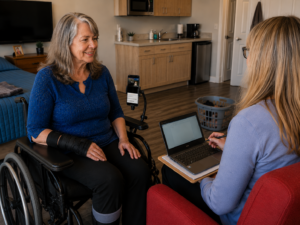
Today, Cheryl’s iPhone is attached directly to her wheelchair using a phone holder. And with APP2Speak on her phone, her communication system is always within reach.
I’ve watched her use it to order food in the assisted living dining room. I’ve watched her participate more independently in daily interactions. I’ve seen her appear more confident and more in control of her communication.
The change wasn’t dramatic in the way people often imagine recovery stories being.
There was no miraculous breakthrough. No sudden return of speech. No overnight transformation.
But there was something equally important: access, participation, and independence.
Cheryl seems happier today. Now one of her biggest frustrations is forgetting to charge her phone, because when the battery dies, so does access to her communication app.
As frustrating as that may be, it also makes an important point: The app has become part of her life.
Not just a therapy tool. Not a device sitting on the floor. A real-world communication solution that she uses every day.
The Right Fit Matters
As we take the time to recognize Aphasia Awareness Month, Cheryl’s story offers an important reminder.
AAC isn’t only for people who recently experienced a stroke. It’s not only for people who are completely nonverbal.
And communication support isn’t something that necessarily ends when therapy ends.
Sometimes the right communication solution is discovered years later, as a person’s needs change. Sometimes the best aphasia communication tools are simply the ones that fit naturally into everyday life.
Because the goal isn’t just to give someone a communication device. It’s to help them participate in the conversations, relationships, decisions, and experiences that make life meaningful.
And when a communication tool helps make that possible, it’s doing exactly what it was designed to do.
If you or someone you know is living with aphasia and finding communication frustrating, it may be worth taking a closer look at APP2Speak to see if it fits their needs and daily life.
To schedule a demonstration, just reach out to us on our Contact page